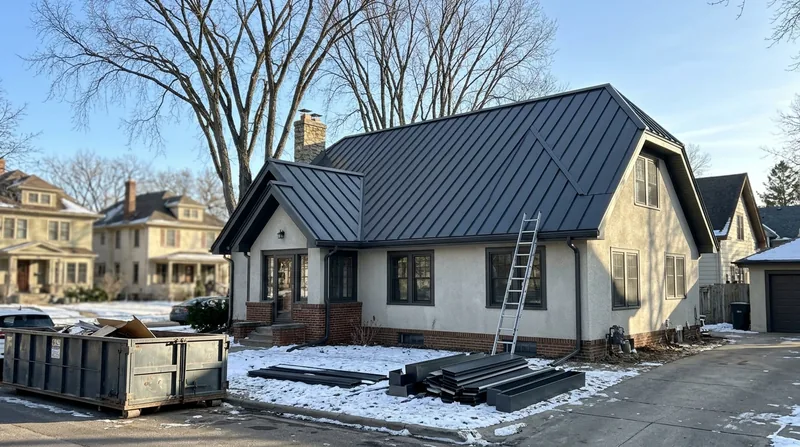




Standing Seam Metal Roofing in Minneapolis
Standing Seam Metal Roofing in Minneapolis is the concealed-fastener system we install most often on the steep gabled and hipped roofs of Powderhorn, Longfellow, Linden Hills and the big cut-up rooflines out in Maple Grove and Woodbury. This city sits on glacial lake-and-river terrain along the Mississippi, around the Chain of Lakes and Minnehaha Creek, under deep snow loads, sub-zero cold and repeated freeze-thaw cycles that punish every exposed fastener on a roof. Our panels are roll-formed to length on site, then mechanically seamed or snap-locked, so there are no screws to back out as the metal expands and contracts through a Minnesota year. A slick standing seam surface sheds snow fast and stands up to hail and straight-line wind that roll through the Twin Cities every summer. If you are weighing this against other systems, start with our metal roof installation page and then come back here for the standing seam specifics.
Why Standing Seam Belongs on Minneapolis Roofs
The dominant failure mode in this city is not wind uplift or rust. It is ice damming at the eaves and fastener fatigue from thermal cycling. A screw-down panel works fine on a shed or a low-slope shop roof, but on a 1920s Craftsman bungalow in Seward or a Tudor Revival in Kenwood with a steep pitch and a warm attic, every exposed screw is a potential leak path once the neoprene washer hardens. Standing seam eliminates that whole category of problem.
- Concealed clips let the panel move with temperature swings from 100°F summer afternoons down to 30 below in January.
- The raised seam profile channels meltwater and rain away from the panel field instead of pooling behind fasteners.
- A smooth painted finish reflects the low, bright winter sun and cuts snow glare on south-facing roof planes.
- Panels span the long rafter runs on 1890s Queen Anne and American Foursquare roofs without a seam every three feet.
- The system handles hail and straight-line wind better than exposed-fastener panels, which matters in a metro that sees tornado-warned storms most summers.
For homeowners in Nokomis, Windom and Richfield sitting on 1930s to 1950s Cape Cods and brick ramblers with low-pitched shingle roofs, standing seam is often the upgrade that finally ends the annual ice dam fight.
Key info: A Linden Hills homeowner with a 1920s stucco Tudor had ice dams at the north eave every February for a decade. We replaced the shingle roof with a 24-gauge standing seam system, added proper underlayment and ventilation, and the eave has stayed clear through the last four winters.
Roofing permits are commonly required for a full replacement in Minneapolis and the surrounding suburbs, and thresholds, fees and inspection requirements vary by jurisdiction. Always confirm the current rules with the local building department before work starts. You can check the City of Minneapolis construction permit guidance at minneapolismn.gov.
How We Install Standing Seam on a Minneapolis House
Every standing seam job starts with a tear-off and a deck inspection, because you cannot hide a soft spot under a panel that will last 50 years. We measure the roof in the field, order coil stock to the correct width and color, and roll-form the panels on site so we are not seaming together short pieces on a long rafter run. The sequence below is how a typical Minneapolis or Edina job runs from first call to final inspection.
- We walk the roof and attic, check decking, ventilation and existing flashing, and photograph anything that will affect the estimate.
- We pull the permit with the local building department and schedule the tear-off around your calendar and the weather window.
- We strip the old roof to the deck, replace any rotten sheathing, and install ice-and-water shield at the eaves and in the valleys.
- We roll-form the panels to length in the driveway and lift them to the roof without dragging them across the ridge.
- We set the panels, install the concealed clips, and mechanically seam or snap-lock every seam depending on the profile you chose.
- We finish the ridge, hips, valleys, chimney and skylight flashing, then install snow guards above the walkways and doorways.
- We clean the gutters, magnet-sweep the yard, and walk the job with you before the final inspection.
If your home is in one of the older Minneapolis neighborhoods, our standing seam service in 55404 covers the Powderhorn and Whittier housing stock in detail.
Key info: On a 2000s two-story in Eden Prairie with four gables, two valleys and a dormer, we roll-formed 18 panels to length in the driveway. That is 40 feet of continuous metal per panel with no lap seam, which is the whole point of standing seam on a complex roofline.
Standing Seam Options We Install
Not every standing seam roof is the same system. The profile, the seam method and the panel width all change how the roof performs under snow load and how it looks on a period home. Here is how the main approaches compare for Twin Cities houses.
| Approach | Description | Best for |
|---|---|---|
| Mechanically seamed | Double-locked seam folded with a power seamer for maximum water and wind resistance. | Steep Minneapolis roofs and any home with a history of wind-driven rain leaks. |
| Snap-lock | Concealed fastener panel that snaps together with no mechanical seaming tool. | Simple gable roofs and budget-conscious replacements in Richfield and Bloomington. |
| Narrow 12-inch panels | Tighter panel spacing that reads more like a traditional seam roof from the street. | Historic-district homes and HOA design-review properties in Kenwood and Lowry Hill. |
| Wide 16 to 18-inch panels | Fewer seams, faster install, and a cleaner modern look on big roof planes. | Large 2000s suburban homes in Maple Grove, Woodbury and Lakeville. |
| Standing seam over existing shingles | Retrofit with sub-framing that levels the new panels above the old roof. | Homeowners who want to skip the tear-off when code allows a recover. |
We match the profile to the house, not the other way around. A Cape Cod in Nokomis gets a different panel than a 2015 colonial in Plymouth.
Standing Seam Metal Roofing Cost in Minneapolis: What to Expect
Standing seam pricing starts from $10 per square foot installed on a straightforward job, and that number moves up or down depending on the roof. Panel gauge, seam method, color, roof pitch, the number of valleys and penetrations, and whether we are tearing off one layer or two all shift the final figure. A simple ranch in Bloomington sits near the low end. A four-gable cut-up roof in Eden Prairie with two dormers and a chimney chase sits well above it. The only honest way to price your roof is on site.
Two or three written estimates from licensed and insured contractors is the smart play, and we encourage it. Ask each contractor what gauge they are using, whether the seam is mechanical or snap-lock, what underlayment goes down, and whether snow guards are included. Those four answers explain most of the gap between a low bid and a real one. Our full pricing overview breaks down the ranges by system so you can compare apples to apples.
Standing Seam Metal Roofing Near Me: Hiring a Contractor Near Minneapolis
When you search for standing seam metal roofing near me, the list you get is long and most of it looks the same. Here is what actually matters before you sign anything.
- Confirm the contractor is licensed and insured, and ask for the certificate of insurance to be sent directly from the carrier.
- Get two or three written estimates that spell out gauge, seam type, underlayment and snow guards, not just a total.
- Ask for references from jobs in Minneapolis or a nearby suburb and call them, especially if your home is in a historic district.
- Understand the permit process for your address, since historic district and HOA design review can restrict panel profile and color.
- Check HOA rules before you pick a color, because a rejected color after the panels are formed is an expensive mistake.
If your roof has storm damage, do not sign anything until you have read our storm and wind damage repair page on how documentation works. We help with insurance claim paperwork, but coverage is always the carrier's decision.
Ready to get a real number on your roof? Call Minneapolis Metal Roofing at (612) 326-1892 and we will set up a free on-site estimate.
Standing Seam Metal Roofing in Minneapolis: Pricing Guide
| Service | Price | Details |
|---|---|---|
| Snap-lock standing seam | Starting at $10/sq ft | Includes tear-off, underlayment, panels and standard trim on a simple gable roof with good access. |
| Mechanically seamed standing seam | Starting at $13/sq ft | Includes power-seamed panels for maximum wind and water resistance on steeper Minneapolis roof pitches. |
| Complex cut-up roofline | On estimate | Multiple valleys, dormers and chimney chases need an on-site measure before we quote a number. |
| Standing seam over existing shingles | On estimate | Retrofit with sub-framing; price depends on existing layer count and whether code allows a recover. |
| Travel | Included | In Minneapolis and surrounding suburbs, no separate call-out or mileage fee on any estimate. |
| Estimate | Free | Response within 24 hours at (612) 326-1892, no obligation to book the job. |
Indicative pricing, the exact cost depends on square footage, finish, and site access. Free personalized estimate within 24h at (612) 326-1892.


